Test for
 (
( known)
( known)
Null Hypothesis
 (
( specified)
Alternative Hypothesis (choose one of the following)
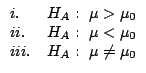
i. and ii. are one-sided of one-tailed, iii. is two-sided or two-tailed.
T.S.

Calculation of p-value (depends on choice of HA).
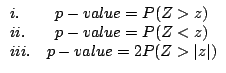
Draw conclusions. If  decision is to be made and
is specified, reject H0 if the p-value is less than of equal to
.
decision is to be made and
is specified, reject H0 if the p-value is less than of equal to
.
Note that the null and alternative hypothesis are specified before the data is collected. If a test is to be conducted at level
,
is specified before data collection.
( known)

( unknown and estimated
by s)
Null Hypothesis
(
specified)
Alternative Hypothesis (choose one of the following)
i. and ii. are one-sided of one-tailed, iii. is two-sided or two-tailed.
T.S.

t has n-1 df
Calculation of p-value (depends on choice of HA).
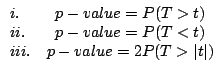
Draw conclusions. If
decision is to be made and
is
specified, reject H0 if the p-value is less than of equal to
.
( unknown
and estimated by s)

| PREVIOUS PAGE |