 = average of the pairs, sd = the standard deviation of the differences and nd =
the number of differences.
= average of the pairs, sd = the standard deviation of the differences and nd =
the number of differences.
Let di = difference between pairs,
= average of the pairs, sd = the standard deviation of the differences and nd =
the number of differences.
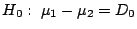
Null Hypothesis
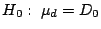 (D0 specified) This equivalent to
Alternative Hypothesis
Choose one of the following:
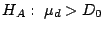 or
or
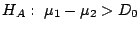
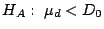 or
or
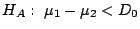
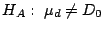 or
or
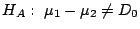
i and ii are one-sided or one-tailed tests. iii is a two-sided or two-tailed test.
T.S.

t has nd-1 df.
Calculation of p-value. Depends on on choice of HA.
Draw conclusions. If  decision is to be made, and
is specified, reject H0 if the p-value is less than or equal to .
decision is to be made, and
is specified, reject H0 if the p-value is less than or equal to .
 (
(
 )
)

| PREVIOUS PAGE |