Test for p, The Population Proportion

Note: Both np and n(1-p) should be greater than or equal to 10 when using this procedure.


1.

Null Hypothesis

$H_{0}: \ p = p_{0}$ (p0 specified)


2.

Alternate Hypothesis

Choose one of the following:

i. $H_{A}: \ p > p_{0}$

ii. $H_{A}: \ p < p_{0}$

iii. $H_{A}: \ p \neq p_{0}$


3.

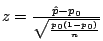
$z = \frac{\hat{p} - p_{0}}{\sqrt{\frac{p_{0}(1-p_{0})}{n}}}$, where $\hat{p} = \frac{x}{n}$


4.

Calculation of p-value

Depends on choice of HA

i. If $H_{A}: \ p > p_{0}$, p-value = P(Z > z)

ii. If $H_{A}: \ p < p_{0}$, p-value = P(Z < z)

iii. If $H_{A}: \ p \neq p_{0}$, p-value = 2P(Z > |z|)


5.

Draw Conclusions. If a decision is to be made, and $\alpha$ is specified, reject H0 if the p-value is less than or equal to $\alpha$.


Note: The null and alternative hypothesis are specified before the data is collected. If a test is to be conducted at level $\alpha$, $\alpha$ is specified before data collection.

Confidence Interval for p


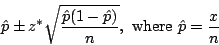
\begin{displaymath}\hat{p} \pm z^{*}\sqrt{\frac{\hat{p}(1-\hat{p})}{n}}, \ \textrm{where} \ \hat{p} = \frac{x}{n}\end{displaymath}


Sample Size Calculations


\begin{displaymath}n = \frac{z^{*}^{2}p(1-p)}{m^{*}}, \ \textrm{where} \ m = \ \textrm{margin of error}\end{displaymath}

If there is noe estimate for p, use p=0.5.


PREVIOUS PAGE

Jonathan Payne
1999-03-31