We wish to investigate whether female university students are, on average, taller than their mothers. A random sample of thirty female students is selected. Each student's height and the height of her mother is recorded. The data is shown below.


- a)
Test whether the daughters are, on average, taller than their mothers. Assess the strength of the evidence against the null hypothesis.
For what values of
 will the null hypothesis be rejected?
- b)
Give a
 confidence interval for the mean difference in height between daughters and mothers.
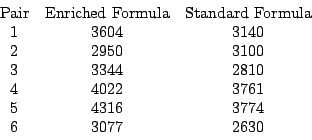
Twelve infants paired according to birth weight were used to compare an enriched formula with a standard formula. Weight gains in grams are given below.
- a)
Test whether the enriched formula is more effective than the standard formula in increasing weight.
What is your conclusion at
 ? What is your conclusion at
 ?
?
- b)
Test whether the mean increase in weight for infants using the enriched formula exceeds the mean increase in weight for infants using the standard formula by more than 300 grams.
- c)
Calculate the
 confidence interval for the mean difference in weight gain between babies fed the enriched formula and those fed the
standard formula.
confidence interval for the mean difference in weight gain between babies fed the enriched formula and those fed the
standard formula.
- d)
Suppose we find the confidence interval in c) too wide and wish to conduct another study with the goal of constructing a
confidence
interval for the mean difference in weight gain which has a margin of error of only 100 g. How many pairs of infants would we need in the
study to achieve the result?