 , (
, ( unknown)
, ( unknown)
n = 45, s = 0.6 sec,
 sec, and
 sec.
sec.
 sec.
sec.
 sec.
sec.
Where mu is true mean time required to inflate a certain type of raft.

since n = 45 and t has 45 - 1 = 44 df
P-value = P(T > 1.118)
0.10 < p < 0.15
The value using the CDF command on the computer is 0.1348.
MTB > CDF.1118;
SUBC > t 44
1.118 0.8652
so 1 - 0.8652 = 0.1348
The p-value is large, indicating little evidence against the null hypothesis.
 .
Since p-value
.
Since p-value  ,
do not reject H0. On the basis of this sample there is not sufficient evidence to reject
claim that the mean inflation time is 7.4 sec. The null hypothesis is not rejected at
,
,
do not reject H0. On the basis of this sample there is not sufficient evidence to reject
claim that the mean inflation time is 7.4 sec. The null hypothesis is not rejected at
,
 or
or
 since in all three cases the p-value is larger than the specified
  .
Conclude that this data does not support the idea that the
inflation is significantly lower than the specified time of 7.5 sec.
.
Conclude that this data does not support the idea that the
inflation is significantly lower than the specified time of 7.5 sec.
t has 44 df. Using the table, use either t with 40 df or t with 50 df.
For 40 df. t* = 2.021.
For 50 df. t* = 2.009.
Using the INVCDF command in MINITAB, for 44 df t* = 2.015
MTB > INVCDF.025;
SUBC > t 44.
.0250 -2.1054
The  confidence interval for
is
confidence interval for
is
 .
.
(7.42 sec, 7.78 sec)
With t* = 2.021 and t* = 2.009 we also get (7.42 sec, 7.78 sec).
n = 10,
s = 8.0 ml,
 or
or

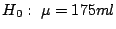
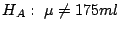
where
is the true mean amount dispensed per cup.

t has 9 df
p-value =
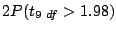
2(0.025 < p < 0.05)
0.05 < p < 0.10
Using the computer the p-value is 2(0.0395) = (0.079).
At
the null hypothesis is not rejected since the p-value is greater than .
Conclude that on the basis of the
evidence in this sample, the machine is not working properly so it is necessary to fix the machine.
At
the null hypothesis is rejected since the p-value is less than .
Conclude the machine is not working properly.
The problem seems to be underfilling.
t has n-1 = 10 - 1 = 9 df.
For a
confidence interval,
t* = 2.262.

The
confidence interval for
is (164.3 ml, 175.8 ml)
For a  confidence interval,
t* = 1.833.
confidence interval,
t* = 1.833.

The
confidence interval for
is (165.4 ml, 174.6 ml)
The
confidence interval for
is (164.3 ml, 174.6 ml). If we wish to test
vs
at
,
we can use the information in the confidence interval to predict the result of the test since we are operating at the same
level of
in both cases (i.e.
and
1 - C = 0.05) and the test is a two sided test. The confidence interval gives a
list of the plausible values for .
The value 175 ml ( )
is contained in
the confidence interval so the null hypothesis
is not rejected at
.
)
is contained in
the confidence interval so the null hypothesis
is not rejected at
.
For the same reasons at
the null hypothesis is rejected since the
confidence interval does not contain the value
175 ml ().
In addition to the usual assumption that the sample is random, since n is small (less than 30) we make the additional assumption that the distribution of a cupfull is approximately normal.
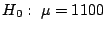
n = 3, s = 36.3 hours,
 hours or
 hours
hours
 hours
hours
 hours
hours
where
is the true mean lifetime of the component

t has 2 df
p-value =
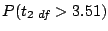
0.025 < p < 0.05
Using the computer the p-value is p = 0.0362)
In this case the consequences of a Type I ()
error are that the component when the mean lifetime is not long enough. This could lead
to failure of the mission.
The consequences of a Type II ( )
error are that the component is not used when the mean lifetime is long enough.
)
error are that the component is not used when the mean lifetime is long enough.
| PREVIOUS PAGE |