- a)
 C.I. for p - proportion of daughters who are taller than their mothers.
n = 30,

x = 18, where x = number of daughters who are taller than their mothers.
 ,
z* = 2.576
,
z* = 2.576
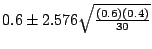

(0.37, 0.83)
C.I. between  and
and  of daughters are tallerthan their mothers.
- b)
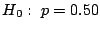
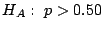

p-value: P(z > 1.10) = 0.1357 = 1 - 0.8643
Do not reject at
 or
or
 .
.
p = proportion of elementary school children with hearing problems in the past. p0 = 0.8
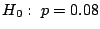
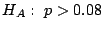
n = 400, x = 35,

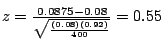
p-value: P(z > 0.55) = 0.2912
No evidence against the null hypothesis. Evidence from the sample suggests no signifigant increase.
p = proportion of trucks with falty brakes
n = 40, x = 14,

- a)
 C.I. for p:
z* = 1.645
C.I. for p:
z* = 1.645
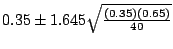

(0.226, 0.474)
The
confidence interval tells us that between  and
and  of trucks have faulty brakes.
- b)
m = 0.05,
C.I.:
z* = 1.645, use

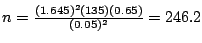 ,
need to test at least 247 trucks.
,
need to test at least 247 trucks.
p = proportion of crayfish in the lake which contain more than 9 parts per billion of mercury.
- a)
m = 0.04,
 C.I.:
z* = 1.96
C.I.:
z* = 1.96
We do not know p, so we will use p = 0.5.
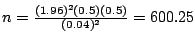 ,
need to analyze at least 601 crayfish.
,
need to analyze at least 601 crayfish.
- b)
Let p = 0.70, m = 0.04,
C.I.:
z* + 1.96
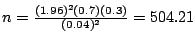 ,
need to analyze at least 505 crayfish.
,
need to analyze at least 505 crayfish.