- a)
 C.I. for

Where
 = mean height for men in population
 = mean height for women in population

t has 15 + 20 - 2 = 33 df. Using table use t30 or t40
t*(30) = 2.042
t*(40) = 2.021


(4.78 inches, 1.49 inches)
- b)
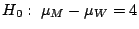
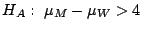

t has 33 df, 0.001 < p < 0.0025
Very strong evidence against H0.
 or
or

 or
or

Where
 = mean number of scientists and inventors chosen by science students.
 = mean number of scientists and inventors chosen by non-science students.


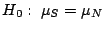
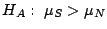
t has 220 + 97 - 2 = 315 df, 0.025 < p < 0.05
 C.I. for

Where
 = mean breaking load for wooden beams. (Type I)
 = mean breaking load for wooden beams. (Type II)

NOTE: if
n1 = n2,

t has 15 + 15 - 2 = 28 df, t* = 2.763
C.I. for


(-46.11, -23.89)
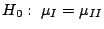 or
or

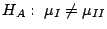 or
or

At
 reject H0 since 0 is not in the confidence interval for