Inferences for $\mu_{1} - \mu_{2}$ (Independent Samples)

Two Sample t-test

Pooled Test (makes the assumption that $\sigma^{2}_{1} = \sigma^{2}_{2}$)

1.

Null Hypothesis

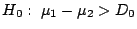
$H_{0}: \ \mu_{1} - \mu_{2} > D_{0}$ (D0 specified)


2.

Alternative Hypothesis

Choose one of the following:
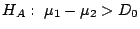
i. $H_{A}: \ \mu_{1} - \mu_{2} > D_{0}$

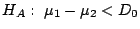
ii. $H_{A}: \ \mu_{1} - \mu_{2} < D_{0}$

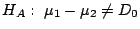
iii. $H_{A}: \ \mu_{1} - \mu_{2} \neq D_{0}$

i and ii are one-sided or one-tailed, iii is two-sided or two tailed.


3.

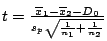
T.S $t = \frac{\overline{x}_{1} - \overline{x}_{2} - D_{0}}{s_{p}\sqrt{\frac{1}{n_{1}} + \frac{1}{n_{2}}}}$

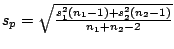
where $s_{p} = \sqrt{\frac{s^{2}_{1}(n_{1} - 1) + s^{2}_{2}(n_{2} - 1)}{n_{1} + n_{2} - 2}}$

t has n1 + n2 df


4.

Calculation of p-value. Depends on choice of HA.

If $H_{A}: \ \mu_{1} - \mu_{2} > D_{0}$ p-value = P(T > t)

If $H_{A}: \ \mu_{1} - \mu_{2} < D_{0}$ p-value = P(T < t)

If $H_{A}: \ \mu_{1} - \mu_{2} \neq D_{0}$ p-value = 2P(T > |t|)


5.

Draw conclusions. If a decision is to be made, and $\alpha$ is specified, reject H0 if the p-value is less than or equal to $\alpha$.


Two Sample Confidence Interval for $\mu_{1} - \mu_{2}$

Independent Samples (Pooled Method)


\begin{displaymath}\overline{x}_{1} - \overline{x}_{2} \pm t^{*} s_{p} \sqrt{\fr...
...+ \frac{1}{n_{2}}}, \ \textrm{where $t$ has $n_{1}+n_{2}-2$ df}\end{displaymath}


Assumptions

1. Independent random samples.
2. Equal variance ( $\sigma^{2}_{1} = \sigma^{2}_{2}$)
3. Normality. If n1 and n2 are less than 30, assume the x1 and x2 are normally distributed.


PREVIOUS PAGE


Jonathan Payne
1999-03-23